
Stress management workshop for employees: name the pressure
Before you book a stress management workshop for employees, ask what pressure it is built for, what people will do in the room and how you will know it helped.
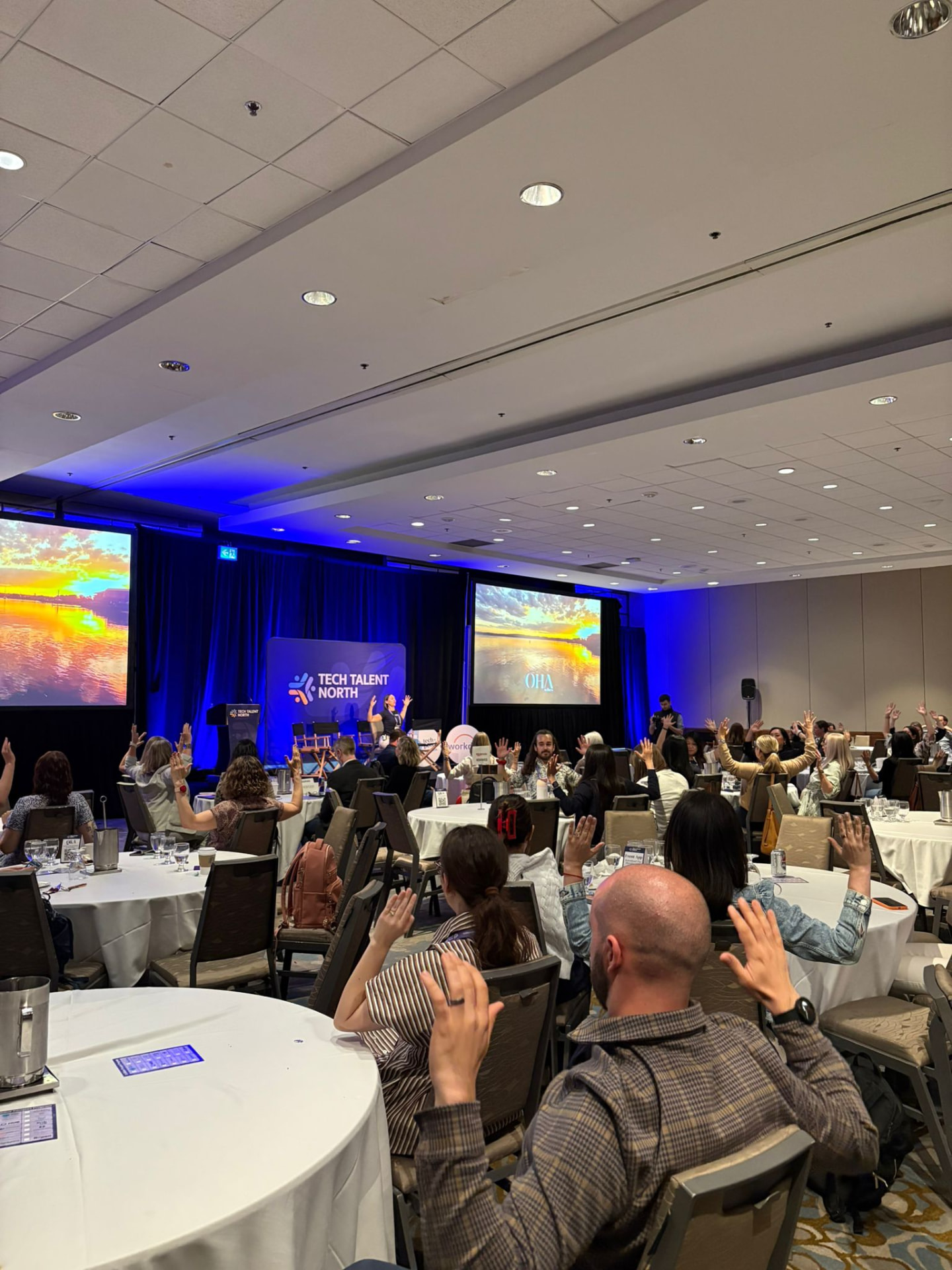
Before you book a stress management workshop for employees, ask what pressure it is built for, what people will do in the room and how you will know it helped. A session aimed at a named pressure leaves you something to look at afterwards; one aimed at stress in general leaves you very little.
The need is real. In April 2023, Statistics Canada found that 21.2% of employed people reported high or very high work-related stress. The questions below help you choose a session that fits the pressure your own teams carry.
What pressure is the workshop meant to ease?
Start with the pressure, named in the words your people use, because a workshop can only be designed around one source at a time. Statistics Canada found that a heavy workload was the most common cause of work-related stress in April 2023, affecting 23.7% of employed people, and that the share reporting high or very high stress reached 27.3% in health care and social assistance.
Workload is one source among several. OHA separates the pressure on a team into the Five Loads: decisional, cognitive, emotional, relational and administrative. Pressure that comes from decision volume calls for a different intervention than pressure that comes from emotional labour, so a good brief names which one the team is carrying.
The check below takes about a minute. It uses five statements, one for each load, so you can arrive at the first conversation with a provider already holding a first answer.
Five Loads quick check · 1 minute
Find the load consuming your team's capacity.
Five statements, about a minute. See all five loads side by side. Answer for your own week, or for the team you are booking for: how often is each of these true?
Statement 1 of 5
What can a stress management workshop realistically do?
The World Health Organization describes interventions for individuals as ones that build skills to manage stress and reduce mental health symptoms, and some research on workplace programs is encouraging. A randomized controlled pilot published in 2012 assigned 239 employee volunteers to a therapeutic yoga program, one of two mindfulness-based programs, or a control group that only completed assessments. Compared with the control group, the programs showed significantly greater improvements in perceived stress and sleep quality, and the online and in-person versions of the mindfulness program gave similar results.
Read that result for what it is: a pilot, with volunteers, of programs. A 2025 meta-analysis of stress management interventions for leaders pooled 25 studies with 2,466 participants and found significant effects on mental health, while noting that the studies varied widely in population, type of intervention, duration and delivery. So ask the provider what the format is, how long it runs and what is meant to follow it.
How will you know the session helped?
Agree the measure before the date, not after. A 2026 review of occupational health interventions, covering mental health, physical health and workplace atmosphere, identified 2,624 studies, found that 68 met its criteria and pooled 23 of them. It found a non-significant reduction in sick days, 0.18 days on average, and a tendency toward a positive return on investment, with statistical uncertainty.
Its authors add that the absence result does not necessarily mean a lack of effect, and they urge standardized evaluation. Pick a measure that matches what the session is for: the same reading of the load before and after is one way, and sick days can sit beside it. Write the measure into the booking: what you will read, when you will read it and who will read it.
That is how OHA's Capacity Circle™ works. It measures a baseline, intervenes on the dominant load and re-measures the same instrument at 90 days, so the result is a change against a baseline rather than a satisfaction score.
Does the workshop change the work, or only how people carry it?
Both matter, and they are different jobs. The WHO says preventing work-related mental health conditions is about managing psychosocial risks in the workplace, and recommends that employers do this through organizational interventions that directly target working conditions and environments. It defines these as interventions that assess, and then mitigate, modify or remove workplace risks to mental health.
A workshop sits on the individual side of that line, and it earns its place there: it gives a team a shared reset. Ask the provider how the session connects to the work itself. At OHA, a workshop is often the first contact, and when an organization wants to know whether pressure is affecting retention or decision quality, the next step is a Capacity Diagnostic. Our approach to workplace stress management shows how the two fit together.
What should a provider tell you before you book?
Five answers, each short enough to fit in a sentence: who the session is for, where it runs and in which language, how long it lasts, what happens after it, and what will be measured.
Who: the whole team, or the managers who carry it. The leader-focused review above found significant effects on mental health, so a session for managers can be a separate booking from one for their team. Where and in which language: in your own office or virtually, in English or French. How long: a single session, or a recurring series across a quarter or a year. OHA offers workshops, team resets and events, built around stress regulation and recovery, and a workshop is a facilitated session on a specific pressure your team is carrying.
What happens after is the answer that separates a good hour from a useful quarter. If the provider cannot say what follows the session, or what you will look at to judge it, the booking is not ready. Ask for the answers in writing, so that the person who signs the budget can see what the hour is meant to change.
What OHA does about this
OHA leads stress workshops, team resets and wellness days for teams in your own office or virtually, in English or French, built on stress regulation and recovery. A session can stand alone; for a measured change, the 90-day Capacity Circle™ measures a baseline and measures again at day 90. Plan a session with OHA and tell us the team and the date.
Book a Capacity DiagnosticSources
- Statistics Canada, Work-related stress most often caused by heavy workloads and work-life balance, The Daily, 19 June 2023 (April 2023 data).
- World Health Organization, Mental health at work, 15 September 2026.
- Journal of Occupational Health Psychology, Effective and viable mind-body stress reduction in the workplace: a randomized…, 2012 (Wolever et al.).
- Scandinavian Journal of Work, Environment & Health, Effectiveness of leader-targeted stress management interventions: A systematic…, 2025 (Dannheim et al.).
- Scandinavian Journal of Work, Environment & Health, Occupational health interventions' impact on absenteeism and economic returns, 2026 (Backes et al.).